- WhatsApp: +994504755728 +8615800837670
- EMAIL: export.import.baku@gmail.com carrie@kacexpo.com
The “Middle Corridor” in a Turbulent World: Why Georgia and Azerbaijan Deserve a Second Look.
When traditional trade routes are blocked and global supply chains are being reshaped, the next direction for overseas expansion is often found in the overlooked corners of the map.
Currently, the Middle East remains turbulent, risks to Red Sea shipping safety persist, and traditional Eurasian land routes face uncertainties due to geopolitical conflicts. Against this backdrop, an increasing number of Chinese companies are re-examining markets they previously paid little attention to.
Georgia and Azerbaijan—two countries in the Caucasus—are moving from “marginal players” to “strategic pivots.” They may not be the largest markets, but they could be the most stable corridors. They may not be the richest countries, but they could be the fastest-growing trade partners.

This article explores four dimensions:
- Why Now? — The “Middle Corridor” dividend in times of turmoil
- What Did Georgia Import from China in 2025? — Data breakdown and industry opportunities
- What Did Azerbaijan Import from China in 2025? — Detailed analysis of five key growth categories
- The “Hidden Thresholds” of Going Global — What to watch out for
01 Why Now? The “Middle Corridor” Dividend in Times of Turmoil
Traditional routes disrupted: The Middle Corridor accelerates its “mainstreaming”
Over the past two years, global supply chains have experienced severe shocks:
- The Red Sea crisis has reduced shipping capacity on the Suez Canal route by about 30%, causing shipping costs to soar.
- The Russia-Ukraine conflict has significantly increased trade risks and compliance costs along the traditional Northern Corridor (via Russia).
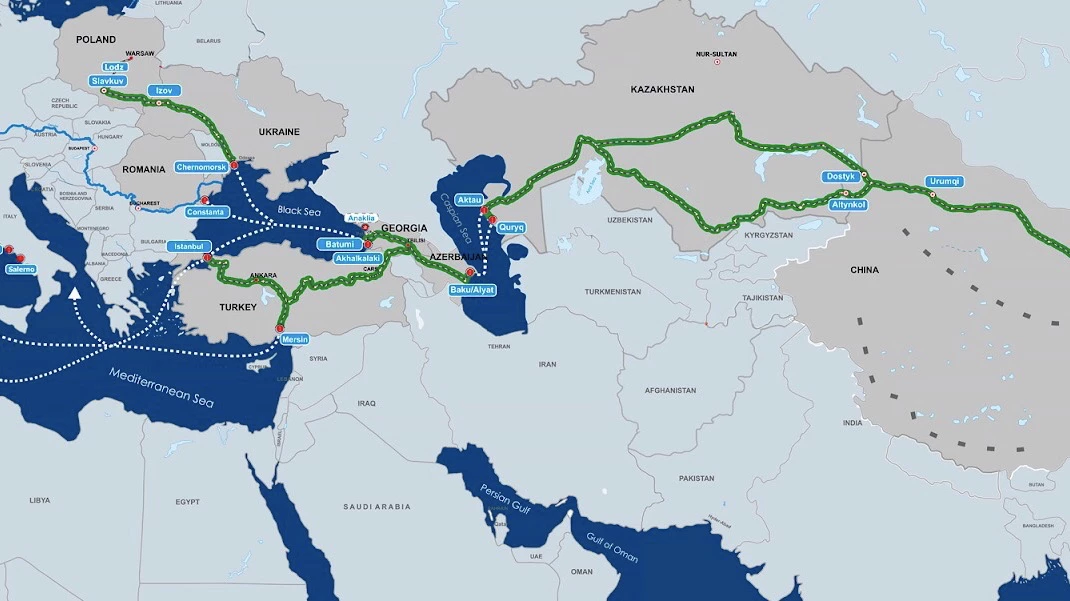
In this context, the Trans-Caspian International Transport Route (commonly known as the “Middle Corridor”) has rapidly upgraded from a “Plan B” to a “strategic option.” This route starts from China, passes through Kazakhstan and the Caspian Sea, reaches Azerbaijan and Georgia, and then extends to Turkey and Europe.
Key Data:
- In the first eight months of 2025, the number of container block trains along the Middle Corridor increased by over 40% year on year.
- Transit time has been reduced from an initial 40 days to 14–18 days.
- Georgia’s Prime Minister disclosed during his visit to China in November 2025 that container freight volume along the Middle Corridor had grown by over 70% year on year.
- Azerbaijan’s Prime Minister stated at the Tbilisi Silk Road Forum that transit freight volume along the Middle Corridor had grown by approximately 90% over the past three years.
Relations with China: Not “swing states,” but “anchors of stability”
Georgia:
- Established a strategic partnership with China in 2023.
- Bilateral trade volume reached $1.6 billion in the first three quarters of 2025, a 15% year-on-year increase.
- The Prime Minister of Georgia explicitly supported the One-China policy at the Shanghai International Import Expo and thanked China for its support of Georgia’s sovereignty and territorial integrity.
- The China-Georgia Free Trade Agreement (effective 2018) covers 95% of Georgia’s exports.
Azerbaijan:
- Azerbaijan’s Deputy Prime Minister stated at the 2025 Import Expo: “Azerbaijan-China relations are at their best period in history.”
- China is Azerbaijan’s fourth-largest trading partner and its largest source of imports.
- Bilateral trade volume reached $3.4 billion in the first nine months of 2025, a 28% year-on-year increase.
- Azerbaijan was one of the first countries to actively respond to and participate in the Belt and Road Initiative.
In a nutshell: In a turbulent international environment, Georgia and Azerbaijan are among the few markets with stable, predictable, and consistently growing relations with China.
02 What Did Georgia Import from China in 2025?
According to the latest data from the National Statistics Office of Georgia (January–September 2025), Georgia’s imports from China reached $1.43 billion, making China its third-largest source of imports (after Turkey and the United States).
Core Import Categories
- Machinery and Electronic Equipment – This is the traditional largest category of Georgia’s imports from China, covering industrial machinery, electronic products, and components. Demand remains stable as Georgia’s infrastructure development and industrialization advance.
- Textiles and Apparel – Chinese-made textiles, garments, and footwear hold a significant share in the Georgian market. Leveraging cost-performance advantages, Chinese clothing is very popular among local small and medium-sized wholesalers and retailers.
- Automobiles and Parts – In the first three quarters of 2025, Georgia’s total automobile imports exceeded $2.8 billion, accounting for more than 20% of its total imports. Chinese auto parts and tires are growing rapidly in the aftermarket.
- Building Materials and Hardware – As several large-scale infrastructure projects advance in Georgia, Chinese building materials are widely used in local construction projects, becoming an important import category.
Notable “Growth Opportunities”
- Infrastructure Materials: The Georgian government is advancing several major infrastructure projects, including the Anaklia Deep Sea Port (planned to become one of the largest ports on the Black Sea), the East-West Highway upgrade, and the railway electrification project. These will generate sustained demand for steel, cement, engineering machinery, and power equipment.
- Consumer Goods Upgrade: As per capita income in Georgia steadily rises, local consumer demand for mid-to-high-end home appliances, smart home products, and consumer electronics is shifting from “whether they exist” to “whether they are good.” This provides a window for Chinese brands to transition from low-price volume to quality premium.
03 What Did Azerbaijan Import from China in 2025?
Azerbaijan’s dependence on Chinese goods is even higher—Chinese goods account for 17.69% of Azerbaijan’s total imports, making China its largest source of imports.
According to data from the State Customs Committee of Azerbaijan, trade volume between China and Azerbaijan reached $3.4 billion in the first three quarters of 2025, a 28% year-on-year increase.
Five Key Growth Categories
- Building Materials and Machinery Equipment (Largest Share)
Azerbaijan is in a phase of large-scale urban renewal and accelerated industrialization. The construction of new urban areas in Baku, the expansion of industrial parks, and the improvement of transportation infrastructure are generating strong demand for construction equipment, hardware, building materials, and power tools.
- Opportunity: Chinese engineering machinery brands like Sany and XCMG have established initial recognition in the Azerbaijani market, but there remains a significant gap for small and medium-sized equipment and tool products.
- Home Appliances and Consumer Electronics
From smart TVs and air conditioners to kitchen appliances, “Intelligently Made in China” has fully penetrated Azerbaijani homes. Brands like Haier, Midea, and Hisense dominate the mid-range market.
- Opportunity: Emerging categories such as smart home products (smart speakers, security cameras) and small appliances (air fryers, robot vacuums) have significant growth potential.
- Automobiles and Parts
Azerbaijan’s car ownership is continuously rising, but the country has almost no automotive manufacturing industry, making it highly dependent on imports for vehicles and components. In the first three quarters of 2025, automobile imports grew about 15% year on year, with Chinese brands’ parts showing noticeable growth in the aftermarket.
- Opportunity: The Azerbaijani government is actively promoting the introduction of electric buses and charging infrastructure, with brands like BYD and Yutong already having projects on the ground.
- Textiles and Apparel
Chinese clothing, with its diverse styles, flexible supply chain, and wide price range, has become the “go-to choice” for local small and medium-sized wholesalers and retailers.
- Opportunity: Fast fashion and functional fabrics (sportswear, outdoor gear) are the fastest-growing subsegments.
- Digital Economy and Green Energy (Core Growth Driver for the Next Three Years)
Azerbaijan has made digital transformation a key direction for national governance. In 2025, China and Azerbaijan signed several cooperation agreements in areas such as smart logistics, IoT, artificial intelligence, and digital infrastructure.
In green energy, Azerbaijan is planning a Caspian-Black Sea-Europe green energy corridor. China’s technological and production capacity advantages in photovoltaics, wind power, and energy storage are highly aligned with its needs.
One assessment: If China’s exports to Azerbaijan over the past five years were primarily “physical goods,” then over the next five years, “digital capabilities + green technologies” will become the new growth engine.
Afterword
In times of global uncertainty, “certainty” itself is a scarce resource.
Georgia and Azerbaijan—two markets with stable relations with China, strategically located along a vital corridor, and with continuously growing import demand—are moving from “neglected corners” to “blue oceans worth reassessing.”
We will continue to provide in-depth previews of exhibitions in Azerbaijan. Stay tuned.
For more information on market access policies, customs data, exhibition schedules, or cooperation opportunities in Georgia and Azerbaijan, please contact us.
— In an uncertain world, position yourself for determined growth.