- WhatsApp: +994504755728 +8615800837670
- EMAIL: export.import.baku@gmail.com carrie@kacexpo.com
New Logistics Hub in Western Asia: How Can Chinese Smart Logistics & IoT Companies Enter the Azerbaijani Market?
Azerbaijan is strategically situated at the crossroads of Europe and Asia, serving as a vital hub connecting Central Asia, Europe, and the Middle East. As one of the first countries to actively respond to and participate in the Belt and Road Initiative, Azerbaijan plays a critically important role in logistics transshipment in the South Caucasus. China accounts for 45% of the region’s trade volume with Azerbaijan, and China is firmly Azerbaijan’s fourth-largest trading partner and its largest source of imports. Chinese goods make up 17.69% of Azerbaijan’s total imports. From January to November 2025, bilateral trade reached US$4.87 billion, a year‑on‑year increase of 30.2%. The bilateral relationship is at its best in history.
More importantly, in recent years Azerbaijan has unveiled ambitious national digital transformation plans. In January 2025, the country approved the “Digital Development Concept of the Republic of Azerbaijan” and designated 2025 as the “critical year for digital economic development.” The 2025–2030 Digital Economy Strategy contains more than 50 initiatives covering the digitalisation of industry and transportation, the application of artificial intelligence, and the creation of digital twins. Azerbaijan is rapidly transforming from a traditional energy-based economy into a new digital hub.
- Policy Tailwinds: Top‑Level Design for Azerbaijan’s Digital Transformation

2.1 Digital Economy Strategy (2025–2030)
The Ministry of Economy of Azerbaijan and the Centre for Analysis and Coordination of the Fourth Industrial Revolution are jointly formulating the 2025–2030 Digital Economy Strategy. The strategy includes more than 50 initiatives covering the public and private sectors as well as civil society. These include industrial digitalisation, the application of AI and other Fourth Industrial Revolution technologies in industrial enterprises, the development of AI solutions based on big data, and the creation of digital twins in agriculture, urban planning, transportation, and other fields.
Specific transformation KPIs have been set: in 2025, Azerbaijan will launch “Industry 4.0” projects, inviting domestic and international experts to study business process models and develop technological roadmaps, with the goal of having 650 enterprises complete digital transformation by 2030.
2.2 Alat Free Economic Zone (ALAT FEA)
The Alat Free Economic Zone is a core vehicle for attracting foreign investment and building a Eurasian logistics hub. In March 2026, an investment promotion conference themed “Focus on Alat Free Economic Zone, Jointly Explore New Opportunities in the Eurasian Market” was held in Beijing, attracting more than 220 representatives from government agencies, energy & power, construction, manufacturing, investment and finance sectors. The FEZ offers tax incentives, simplified customs procedures, and other preferential policies, making it an ideal entry point for Chinese companies looking to deploy smart logistics and IoT businesses in Azerbaijan.

III. Market Status: Development Foundation for Smart Logistics & IoT in Azerbaijan
3.1 4G/5G Network Infrastructure – The “Highway” for Smart Logistics

Good communications infrastructure is a prerequisite for the development of smart logistics and IoT. Azerbaijan has already achieved remarkable results in network construction: it has built 4G infrastructure covering 98% of its population and is deploying 5G trial networks in major cities. In Q1 2025, mobile internet penetration reached 76%, and average monthly data usage per user exceeded 12GB, indicating a high degree of digital maturity.
At the operator level, Azercell holds the largest market share (approx. 48‑51%), with 4G coverage of about 94‑98% of the population and territory. In 2023, it installed more than 300 new LTE base stations and modernised over 1,600 existing sites, doubling the average internet speed. The fibre‑optic backbone built along the Baku‑Tbilisi‑Kars railway has significantly improved east‑west communication efficiency, providing a foundation for real‑time transmission of big data in smart logistics.
3.2 Cross‑Border Logistics Hub – The Middle Corridor and Trans‑Caspian Route
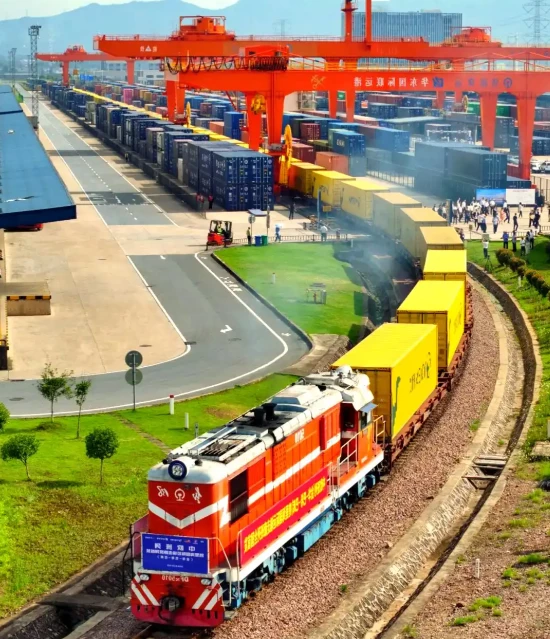
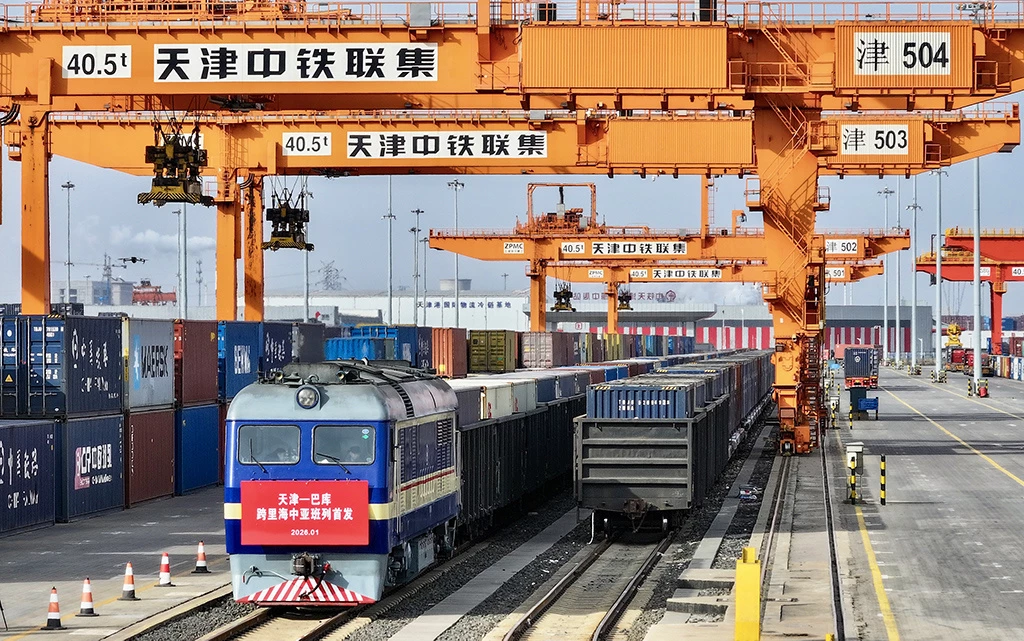
Azerbaijan is a key node of the Trans‑Caspian International Transport Route (TITR), also known as the “Middle Corridor”. Since 2026, the China‑Europe freight train (Wuhan) has opened a new route to Baku, Azerbaijan. Leaving China via the Khorgos Port, crossing Kazakhstan, and then connecting to the southern Trans‑Caspian International Transport Corridor, the “rail + sea” intermodal service delivers seamless connections, with the entire journey expected to reach Baku in 18 days. Tianjin has also launched its first Trans‑Caspian Central Asia train to Baku, using a “sea‑rail‑sea” intermodal model; after arriving in Baku, goods can be further distributed to Turkey and many other countries and regions.
Baku and the Kazakh port city of Aktau face each other across the Caspian Sea, both serving as important nodes of the Trans‑Caspian intermodal transport corridor. With the stable operation of the southern route of the China‑Europe Railway, Azerbaijan is becoming a key logistics hub connecting China with Europe and the Middle East.
3.3 E‑commerce Explosion – Surging Logistics Demand
Azerbaijan’s e‑commerce market is growing at high speed. According to Statista, the Azerbaijani e‑commerce market is expected to exceed US$1.76 billion in 2025, with an average annual growth rate of 10.47% over the next few years, potentially reaching US$2.751 billion by 2029.
In cross‑border e‑commerce, Russian platform Ozon officially entered the Azerbaijani market in August 2024. On Ozon’s local page in Azerbaijan, more than 8 million products from Chinese sellers are already available. Annual revenue growth in Azerbaijan’s e‑commerce sector is projected to reach 24% by 2028. The explosive growth of e‑commerce is driving an urgent need to upgrade smart logistics infrastructure.

- Which Chinese Companies Are Already Active in Azerbaijan’s Smart Logistics & IoT Space?

4.1 Smart Logistics & Supply Chain Services
China Railway Container Transport Corp., Ltd. has joined Middle Corridor Multimodal Ltd., a company registered in Astana in 2023 by the railway authorities of Kazakhstan, Azerbaijan, and Georgia. The aim is to integrate and coordinate various transport resources and provide customers with freight forwarding services along the Middle Corridor, with unified pricing for the entire journey.
Sichuan Port & Logistics Investment Group’s Luhaiyun Port has engaged with the Azerbaijan Railways (ADY), Caspian Shipping Company, Baku International Sea Port, and Baku Shipyard to deepen logistics cooperation across the Trans‑Caspian route, focusing on synergy in rail, sea, road and air transport.
China United Logistics Group now operates four freight trains per month on the southern corridor. Cargo departs from the Khorgos Port, travels by rail to Aktau, is transferred by sea to Baku Commercial Port, and has successfully completed the first “door‑to‑door” delivery service in the Caucasus region, achieving a breakthrough in last‑mile coverage.
Shanxi Huayuan International Land Port Group, together with China Railway Taiyuan Group, China Railway Container Transport, and others, launched Shanxi’s first “Trans‑Caspian” international train, delivering photovoltaic modules efficiently to the Caucasus, Turkey, and Eastern European countries.
4.2 IoT & Digital Solutions

Xiamen Ccore (magnet technology) provides an intelligent transport system (ITS) for public buses in Baku, equipping buses with route signs, surveillance, ADAS, DMS, and other auxiliary functions, along with an ITS that enables cloud‑based real‑time monitoring of vehicle and battery data, providing a “digital & intelligent” backbone for Baku’s bus operations – a replicable smart‑transport model for countries along the Belt and Road.
Zhongke Yixing signed an order on the first working day of 2025 to supply 2,000 advanced customised communication IoT data‑collection terminals and a supporting intelligent digital platform for energy consumption management – marking the first batch application of its products in Azerbaijan and breaking new ground for Chinese IoT companies in the field of smart energy consumption data collection in the country.
Huawei is also actively expanding in Azerbaijan. A delegation from the State Oil Company of Azerbaijan (SOCAR) held in‑depth discussions with Huawei management during a business visit to China, planning to invite Huawei to implement digital solutions and intelligent control systems in Azerbaijan’s natural gas infrastructure to improve operational efficiency and deploy innovative technologies in energy management.
- Market Opportunities
- Policy dividend window:Azerbaijan regards telecommunications as the second‑largest economic growth engine after its energy sector. The government’s top‑level push for industrial digital transformation sends a clear market signal to Chinese companies.
- Continuous improvement of logistics corridors:The launch of the Trans‑Caspian International Transport Route has significantly improved China‑Azerbaijan logistics efficiency, offering a new international logistics choice with better transit times and higher security for high‑value goods.
- Surging demand from e‑commerce and smart logistics:The e‑commerce boom is generating strong demand for smart warehousing, intelligent delivery, digital customs management, and related services.
- Digitalisation of energy and transport is an urgent need:Azerbaijan is vigorously driving digital transformation in traditional industries such as oil and gas. Demand is strong for IoT collection equipment, industrial 5G private networks, energy management systems, and more.
Conclusion

Azerbaijan stands at a critical juncture in its digital economy transformation. The release of the 2025–2030 Digital Economy Strategy signals that this Caspian nation is fully committed to seizing the high ground in Eurasia. Chinese companies such as China Railway Container Transport, China United Logistics, Xiamen Ccore, and Zhongke Yixing have already taken the first steps, but the market remains far from saturated – opportunities still lie ahead.
From 21 to 23 September 2026, the 8th Smart Life Expo Azerbaijan will be held at the Baku Expo Center, featuring sections on consumer electronics, smart home, automatic control systems, and more. It is an ideal springboard for Chinese smart logistics and IoT companies to enter the South Caucasus market. Seize the window – go to Baku and meet your next growth opportunity.